


A Glue-on Horseshoe You Can Rely on
Wolf Busch® glue-on tabs have already earned their place in our company history. We assume that - no matter what may come - they are and will remain the most successful product of our Innovations test range ever.
Together with the former developer team RB-Carbon, consisting of Wolfgang Busch and Christian Roncassaglia, we have launched the glue-on tabs in 2019 as part of our Innovations range as the first product "powered by Duplo". Due to the dissolution of the development team, we were forced to rename the product "Wolf Busch® glue-on tabs".
Simple assembly and long durability - these were the requirements that the two developers set themselves as their goal. Both goals were met.
Among our customers, these glue-on tabs, which just like our composite horseshoes are a 'composite' of two materials, have triggered a real gluing boom! At first glance, the amateur thinks: "Anyone can glue". In practice, however, a reliable glue-on horseshoe depends on many factors. On the one hand, of course, on the product used. But when it comes to gluing in particular, there are many other aspects that determine success or failure.
Our goal is to provide you with high-quality products for your glue-on shoe and to support you with a general insight into the topic of "reliable glue-on horseshoes" - because every product can only be as good as its user.
If you would like to contribute something at this point, we would be happy if you leave us your tips and tricks in the form of an item review. Of course, we are also available for a personal conversation.
Durability of the Glue-on Tabs
In the case of a plastic horseshoe, it has long been understood that the duration of the storage of the finished product has an effect on the abrasion resistance . However, what is advantageous for the horseshoe can be a disadvantage for a glue-on tab - not in terms of tear resistance, but with regard to its flexibility and pliability.

Thanks to our close collaboration with active farriers, we are able to incorporate this hands-on feedback directly into product optimization. To consistently ensure optimal quality, we deliberately keep lower stock levels of the colored variants. This allows us to make sure that you receive products that are as "fresh" as possible. If a color is temporarily unavailable, we kindly ask for your understanding – this is solely to maintain the quality of the adhesive tabs.
At the same time, we would like to ask you to apply these findings to your own storage. Please use Wolf Busch® glue-on tabs as soon as possible on a "first in first out" basis and observe the shortened return period of one month on our glue-on tabs. After receipt, the glue-on tabs should be used as soon as possible and no later than within a maximum of 5 months.
Wolf Busch®: Regular vs. Colored vs. Soft
Everyone already knows it from our horseshoes: There is the Standard model and the Extra models . Different plastic or different degrees of hardness have different properties depending on temperature and ground conditions. The same applies to Wolf Busch® glue-on tabs, except that the focus in this case does not lie on abrasion but on tear resistance and flexibility in terms of the application to the hoof. As requirements vary in this area as well, the popular tabs are available in different hardness levels.
At this point, we provide a general guideline to help you determine which glue-on tab variant is more or less suitable. This information is not intended as a fixed rule, but as support in selecting the right glue-on tab for your glue-on shoe. In addition to our recommendations, other factors always play a decisive role – including the horse's workload, the specific riding discipline, and its individual gait mechanics. These aspects have a significant influence on the durability of the glue-on horseshoes on the hoof.

| Wolf Busch® Glue-On Tabs | 'soft' | 'regular' with color additive | 'regular' |
|---|---|---|---|
| Cold Winter Temperatures | well suited | suitable, but slightly more difficult to handle during gluing | suitable, but more difficult to handle during gluing |
| Moderate Temperatures | well suited | well suited | well suited |
| Hot Summer Temperatures | Not recommended: increased risk of premature loss of the glue-on shoe | Generally suitable, but slightly softer than the version without color additive – if in doubt, please choose the regular tabs | Suitable |
| Hooves with Strong Rotation or Sliding Movements | Not recommended: increased risk of premature loss of the glue-on shoe | Generally suitable, but slightly softer than the version without color additive – if in doubt,
please choose the regular tabs We recommend using a base plate model with quarter clips to minimize the risk of premature loss of the glue-on shoe. |
Generally suitable We recommend using a base plate model with quarter clips to minimize the risk of premature loss of the glue-on shoe. |
| Show Jumping and other High-Impact Disciplines | Not recommended: increased risk of premature loss of the glue-on shoe | Generally suitable, but slightly softer than the version without color additive – if in doubt,
please choose the regular tabs We recommend using a base plate model with quarter clips to minimize the risk of premature loss of the glue-on shoe. |
Generally suitable We recommend using a base plate model with quarter clips to minimize the risk of premature loss of the glue-on shoe. |
| Irregular Hoof Wall Shapes | Well suited | Suitable, but slightly more difficult to handle during gluing | Suitable, but more difficult to handle during gluing |
Wolf Busch® Gluing Tabs – Photos

Adjust the shoe to the shape of the hoof. Allow it to extend approx. 1mm over the hoof in the area of the gluing tabs.

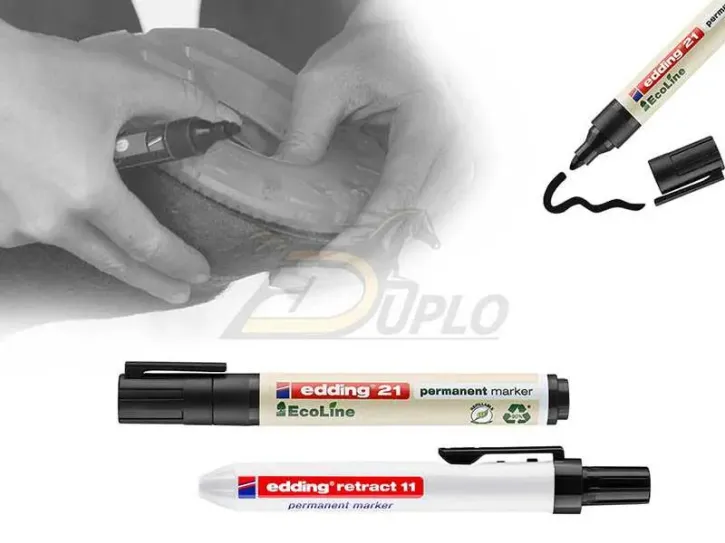
Grind off all knobs before plastic-welding the glue-on tabs to the shoe. This applies both to the solid, colored knob arrays and to the soft, production-related knobs.

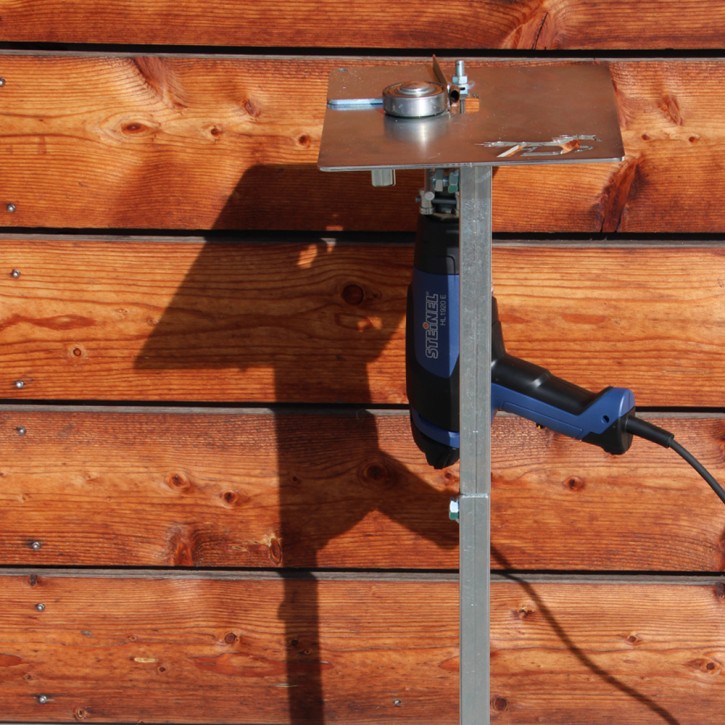
Our tip: regular and stable welding seams can be achieved with the help of our plastic welding device.

The clips provide additional protection against twisting on the hoof during the regular shoeing period.

In order to use the glue tabs in combination with a clipped composite horse shoe, divide it after the largest tab.

Place the two largest tabs before the clips. If you have only little space, exchange the right tab with the left tab.

You can adjust the shoe to the individual requirements of the horse. It is also possible to combine a glued and nailed application. The photo shows a clipped horseshoe, which has been half-glued and half-nailed to the hoof, with a wedge .

The Wolf Busch® glue-on tabs are also ideal for use in combination with our open-toed horseshoes . Many of our customers use this special shoe, e.g. in case of laminitis .

Donkey hooves also sometimes need a shock-absorbing glue-on shoe. In this case, we have found a good solution: A glued hoof protection made of two glue-on tabs and an un-clipped horse shoe.
Application and Safety Information – Reliable Glued Horseshoes – VIDEO
Whether it is a nailed or, as in this case, glued horseshoe: There are certain safety instructions that you must take into account for the application and use of our products. Please read and follow our safety advice in order to avoid injuries to humans and horses.
Gluing Horseshoes - Step by Step
In the field of glued horseshoes, other factors come into play in addition to the right superglue. These are, among other things, the correct barefoot treatment, the ideal customization of the shoe to the horse's hoof, a stable plastic welding seam, and the climatic conditions.
But don't worry: With the right equipment, a proper working method, and a bit of manual skill, a reliable end product can be created despite these many factors. In our video the farrier Shelly Huber explains the correct application of the Wolf Busch® glue-on tabs.
If you prefer written gluing instructions, you can find them in our FAQ section → Instructions.

Using the Wolf Busch® Glue-On Tabs
Gluing in Case of a Clipped Hoof Protection
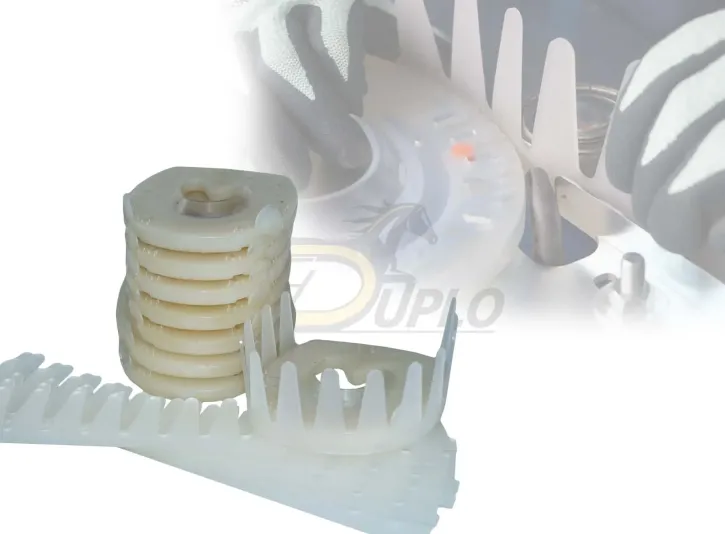
If you want to combine the Wolf Busch® glue-on tabs with a clipped horseshoe, cut the gluing tabs between the largest and the second-largest tab. Place the largest tab in front of the clip and the other two tabs behind it.
If you run out of space in the toe area, it may happen that the two largest tabs overlap. For more space in the toe area, you can exchange the two largest tabs, as shown on the photo.
Please note that this procedure also applies if you have removed the clips from a clipped composite horseshoe. It is not possible to create a welding seam in the area where the clips have been ground off.
Removing a Glued Horseshoe
With successful glued shoeing, you will ultimately face the challenge of removing the glue-on tabs from the hoof without damaging the hoof wall. Of course, as always, different working methods lead to the intended goal.

Removing Glue-On Horseshoes with Pliers
One option is to use pliers to remove the glued horse shoe. Grasp the glued tab at the uppermost point and carefully pull the tab off the hoof. Many people like to use this method because it is simple and fast. The big disadvantage of this method is, however, that it can happen that you damage the hoof wall.
Removing Glue-On Horseshoes with a Hoof Knife
A more gentle method for the hoof wall would be to use the hoof knife to carefully separate the black connecting layer between the tab and the hoof from the top to the bottom. The remains of the inner layer of the glue tabs can then simply be rasped away during the usual treatment of the bare hoof. Ensure adequate ventilation, as the fine adhesive debris generated during rasping poses health risks.
Reusability of the Glue-on Tabs and/or the Glue-on Horseshoe
With our horse shoes, it is already quite normal for many customers to have the ability to use a nailed shoe multiple times. Of course, this statement cannot be generalized as the abrasion resistance and thus also the reusability depends on many aspects. We recommend against reusing a composite horse shoe if the metal core is no longer completely covered by the plastic sheath. The final decision whether a shoe can be used again is always the responsibility of the farrier on site.
If you decide to reuse a horseshoe, it is important to straighten it before re-shoeing. This way, you will avoid tension and pressure on the hoof during the next shoeing period.
For the reusability of a glued composite horse shoe, the following requirements must be met:
- The composite or pure plastic horseshoe is reusable.
- The welding seam between the glue-on tabs and the horse shoe is completely stable and can withstand a new tear test.
- The glue-on tabs do not have any cracks.
- The inside of the Wolf Busch® gluing tabs is still completely covered with the black inner layer.

Removing Adhesive Residue
If these requirements are met, you still need to remove the remains of the superglue from the gluing tabs. The residues of the old glue would have a negative effect on the new glued connection.
If you grind off the remnants of the superglue, be aware that the grinding dust of the glue bears health risks. For your own safety, we therefore advise you to wear protective eyewear in combination with a FFP3 mask and ensure adequate ventilation. You can also buy this safety equipment from us.
Reusable Base Plate with Unusable Glue-On Tabs
Of course, it is also possible that you can reuse the shoe but the glue-on tabs are not suitable for another shoeing cycle. This is the case as soon as the black inner layer of the gluing tabs is no longer completely visible, or if the tabs have cracks. In this case, we recommend that you grind the remainders of the old glue-on tabs off the horseshoe before plastic-welding it with new glue-on tabs. As always, please make sure not to inhale any grinding dust.

Optimized conditions for a second shoeing period with the Duplo Nailless
At this point, we would like to briefly refer to our Nailless model, where the chance of re-using the composite horse shoe is higher.
From the point of view of abrasion, many customers could reuse their glued horse shoes, but have problems with small cracks in the plastic in the area of the knob arrays.
This is a phenomenon that can occur especially with a glued horse shoe. Due to the hoof growth, tractive forces are exerted on the shoe. These forces have a different effect on a glued shoe than on a nailed shoe. For this reason, the Nailless is being produced without knob arrays.
Product Specifications
| General Data and Delivery Information | |
|---|---|
| Model | Wolf Busch ® Glue-On Tabs |
| Brand | Wolf Busch® |
| Manufactured in | Germany |
| Packaging Unit | The glue tabs are sold in pairs. One pair is typically needed per hoof. |
| Echange and Return |
Possible under certain conditions within 1 month within the
European Union
(EU). For returns outside the EU, please contact our customer service. Full details are available under FAQ → Service & Conditions. |
| Function and Application | |
|---|---|
| Funktion | alternative hoof protection, glue-on horseshoe, adhesive application |
| Riding Styles & Disciplinesn | among others: leisure riding, trail riding, endurance riding , western riding, dressage , gaited horse riding, baroque riding, groundwork, cross-country riding, Working Equitation |
| Horse Breeds | among others Warmbloods, Thoroughbreds, Quarter Horses, Paint Horses, Haflingers, Icelandics, Arabians, Friesians, Andalusians, Hanoverians |
| Hardness / Season | With different hardness levels available, there's a suitable Wolf Busch® adhesive tab for every season. For more details, please see the table above, where the three variants – Regular, Soft, and Colored – are clearly compared. |
| Größen und Farbe | |
|---|---|
| Sizing | Size is based on the glue-on horseshoe used.
|
| Inner layer | black elastomer |
| Versions |
Regular without color additive (base material) Regular in hoof colors (light and dark) Regular in special colors (blue, green, pink) Soft in light green |
| Shoeing and Customization | |
|---|---|
| Application | Glue-on Shoes |
| Therapeutic Use | The glue-on tabs can also be used in combination with our horsehoes for support in orthopedic and therapeutic applications. Please note that our products are not intended to diagnose or cure medical conditions. We strongly recommend working closely with a hoof care professional or veterinarian in such cases. |
| Gluing Instruction | Available under FAQ → Instructions |
| Customization | Check the height of the tabs and their correct position on the hoof. If a glue-on tab is placed not only on the hoof wall but also on the coronary band , the adhesive bond will be unstable. |
| Compatible shoes | With the exception of the Duplo Arizona , the glue-on tabs can generally be combined with all plastic and composite shoes in our range. They are compatible with standard and extra shoes as well as models made from regranulate . Depending on the plastic compound and temperature, it may be necessary to adjust the hot air gun temperature and the feed speed during welding. |
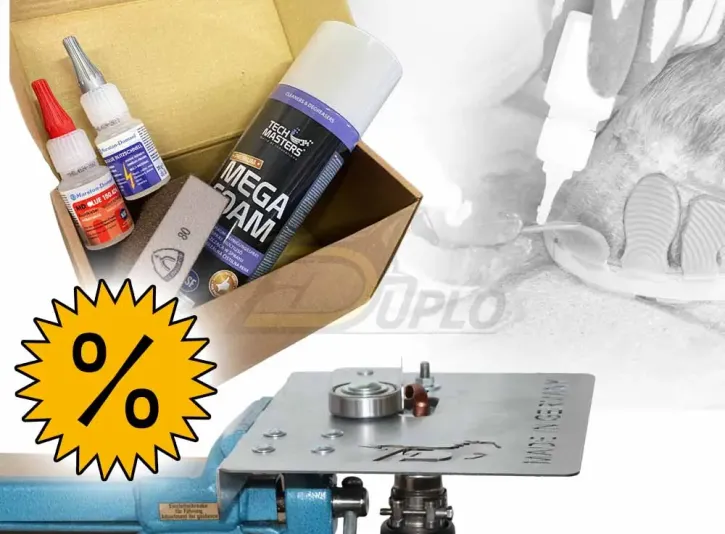
| Accessories | Adhesive, hoof cleaner, sanding block, welding fixture, hot air gun with reduction nozzle , Glue-U Activator |
| Safety Instructions | |
|---|---|
| Safety Information | can be found unter FAQ → Safety Information |
| Safety Instructions as PDF Download | PDF Download |
Reasons for Lost Glue-On Shoes – Key Factors for Successful Gluing

With glue-on shoes, it is important that the bonded connection is strong enough to keep the shoe securely in place. At the same time, it should be able to give way in an emergency to prevent injury to the horse's tendons and ligaments. To ensure this balance and achieve an optimal ratio between bonding surface and hoof size, Wolf Busch® glue-on tabs have been developed in various sizes.
A lost glue-on shoe is often the result of such an emergency. What may seem negative at first glance is actually a positive outcome: if the tabs did not give way when needed, the situation could require a vet instead of a farrier.
If your horse frequently loses a glue-on shoe prematurely, it is worth taking a closer look at the different factors involved. For this purpose, we have provided a helpful FAQ guide.
FAQ Guide: Why Doesn't a Glue-On Shoe Hold?
Why does a glue-on shoe come off even though the weld seam is intact?
If a glue-on shoe comes off even though the weld seam is intact, the cause is usually not the welding itself, but rather the adhesive bond or mechanical stress. In many cases, several factors play a role – from the size of the glue-on tabs to the stresses of the horse's daily activity.
Can the size of the glue-on tabs make a difference?
Yes. To achieve the most optimal ratio between bonding surface and hoof size, the size of the glue-on
tabs should match the selected shoe size.
If the glue-on tab is too small, it provides insufficient bonding surface. If it is too large, it may
not fit properly on the hoof or may even touch the coronary band, which can significantly reduce the
durability of the bond.
In some cases, it may therefore be advisable to choose one size up or down. Always check carefully
whether the selected size is optimal for the individual hoof.
As a general guideline:
- Glue-on tab size 1 for horseshoes from 50 mm to 70 mm (3D printed)
- Glue-on tab size 2 for horseshoes from. 70 mm to 90 mm (3D printed)
- Glue-on tab size 3 for horseshoes from 90 mm to 114 mm
- Glue-on tab size 4 for horseshoes from 114 mm to 134 mm
- Glue-on tab size 5 for horseshoes from 134 mm to 162 mm
- Glue-on tab size 6 for horseshoes from 162 mm to 198 mm
Do glue-on tabs need to be adjusted to the hoof?
As a rule, no manual adjustments are necessary if the correct size has been selected. However, you should always check the height of the tabs. If they are too high and would extend onto the coronary band, they should be trimmed accordingly.
Why should glue-on tabs not be placed on the coronary band?
If glue-on tabs are placed not only on the hoof wall but also on the coronary band, the adhesive bond becomes unstable. This can result from tabs that are too large or from incorrect placement. If the tabs are too large in the rear area of the hoof, the issue can be easily corrected: simply trim a small amount from the top to keep the coronary band clear.
Does the glue-on shoe need to be precisely fitted to the hoof?
Absolutely. The shape and size of the glue-on shoe must be precisely adapted to the hoof. In the area of the glue-on tabs, allow approximately 1 mm of material to extend beyond the hoof to create a proper weld seam. Before attaching the glue-on tabs to the shoe, remove all knobs – both the colored integrated knob arrays and the softer ones resulting from the manufacturing process.
Why must all knobs be removed before bonding?
This step is necessary because otherwise the tabs may compress afterward if the knobs were not fully pressed into the bearing edge during bonding. This subsequent compression can negatively affect the durability of the glue-on shoe.
Can a horse pull off a glue-on shoe itself?
Yes, this happens more often than you might think. Some horses tend to strike their front hooves with their hind hooves, even when the shoe is properly fitted. In such cases, it can be helpful to apply additional overreach protection on the ground surface of the horseshoe. Make sure to grind down the plastic coating only up to a maximum of half its thickness. This additional cut in the heel area allows the shoe to give way more easily.
Why doesn't the adhesive bond between the hoof and the glue-on tab hold?
If the entire glue-on shoe remains intact but the glue-on tabs detach from the hoof, the cause is usually related to hoof preparation, environmental conditions, or the handling of the adhesive.
What mistakes can occur during hoof preparation?
Various mistakes can occur when preparing the hoof for bonding. Common issues include insufficient
roughening of the hoof surface or inadequate cleaning. Poor degreasing of the hoof or the glue-on shoe
can also reduce adhesion, as can touching the glue-on tabs with your fingers after degreasing.
In addition, using unsuitable cleaning agents, such as brake cleaner, may damage the material. Another
frequent mistake is drying with linting cloths, which can leave residues on the hoof or glue-on
tabs.
A clean, grease-free, and properly roughened surface is essential for a strong and durable adhesive
bond.
Why should brake cleaner not be used on glue-on tabs?
Both acetone-based and acetone-free brake cleaners reduce the tear strength of the black Elastomer used in the glue-on tabs. Depending on the intensity and duration of exposure, this effect can range from barely noticeable to severely damaging. Since it cannot be ensured that such products are applied briefly and gently enough, their use on Wolf Busch glue-on tabs is generally not recommended.
What role do moisture and ambient temperature play when bonding to the hoof?
Moisture and ambient temperature play a crucial role when bonding to the hoof.
Especially in summer, the hoof and the surrounding air can become too dry. Many adhesives require a
certain level of humidity to activate properly. If this is lacking, the adhesive may cure faster on the
glue-on tab than on the hoof. In addition, insufficient moisture can slow down the overall curing
process. How an adhesive reacts under very dry conditions can vary depending on the product used.
For summer conditions, we recommend using a dedicated summer adhesive such as Marston-Domsel "Summer
Glue" or Top2Glue "Gel".
Can glue-on shoes be applied at low temperatures?
Yes. Regular Wolf Busch® glue-on tabs can generally be used year-round. However, at lower temperatures, the tabs tend to be less flexible, which can make it more difficult to apply them evenly and securely to the hoof wall . Wolf Busch® Soft glue-on tabs have been specifically developed for winter use. Choosing the right adhesive is also important in colder conditions. As the viscosity of the adhesive changes with temperature, we generally recommend using a winter adhesive such as Marston-Domsel "Winter Glue" or Top2Glue Medium.
Is more adhesive always better?
No – quite the opposite. When bonding, less is often more. Flooding the glue-on tabs with adhesive does not automatically improve hold and can even have a negative effect on the bond.
What can help if the glue-on tabs are difficult to fit against the hoof wall?
If the glue-on tabs are difficult to position due to their stiffness or the shape of the hoof wall, it can help to gently warm the finished glue-on shoe and then let it cool while resting on the tabs. This creates a slight curvature, allowing the tabs to conform better to the hoof wall and making them easier to bond.
Can old adhesive cause problems?
Yes, old adhesive can cause problems when bonding to the hoof. Even if the adhesive is generally suitable, it can lose its bonding strength if it has been opened for a longer period and has absorbed moisture from the air.
How can I speed up the bonding process?
There are generally two ways to speed up the process:
-
Using a faster adhesive
The Marston-Domsel "Blitzschnell" (instant adhesive) is particularly suitable, as it typically provides reliable bonding and cures very quickly – both in summer and winter. -
Using an activator
Another option is the PRE FIX Activator from glue-u. This is especially helpful for restless horses or when a horse cannot stand still for long due to health reasons.
Apply the adhesive to the glue-on tab as usual. Then spray a small amount of activator specifically onto the area of the hoof where the tab will be attached. Avoid spraying the entire hoof. Then press the glue-on tab onto the hoof. When pressed together, the adhesive reacts with the activator – this chemical reaction significantly accelerates the bonding process.
How important is the resting period after bonding?
Very important. If the horse is subjected to excessive stress before the adhesive has reached its final strength (often around 24 hours), the bond may fail or become permanently weakened. After application, the horse can of course return to the paddock or pasture as usual, but should not be fully loaded before the adhesive has fully cured.
When is the weld seam the cause of a lost glue-on shoe?
If the glue-on tabs are still firmly bonded to the hoof but the shoe itself has come off, the cause is usually an unstable weld seam.
How can you recognize a stable weld seam?
The key indicator is a smooth, glossy bead visible along the entire weld line. This shows that the material has been properly fused.
Do I need a special tool to create stable weld seams?
Yes and no. A special tool is not strictly required to create stable weld seams. However, experience shows that many users find it easier to achieve consistent and therefore more stable weld seams when using our specially developed welding tool.
What factors are critical when welding?
A stable weld seam primarily depends on consistent and sufficient pressure, the correct rolling speed, and the appropriate temperature of the hot air tool. Since the plastics used in the different glue-on tabs – whether regular, soft, or with or without color additives – have slightly different melting points, these parameters must be adjusted accordingly depending on the product used.
Why should weld seams not be cooled with cold water?
Cooling weld seams with water is not recommended, as it can make the plastic brittle.
Should the weld seam be checked before bonding to the hoof?
Absolutely. We always recommend performing a tear test once the weld seam has cooled. This allows faulty
or uneven weld seams to be identified and corrected early, before the shoe is applied to the horse.
Don't worry – you cannot pull too hard during this test, as the forces acting on the shoe at the horse's
hoof will always be significantly greater.
Didn't find the answer to your question? Feel free to contact our team or take a look at our detailed bonding guide alongside this FAQ. It covers many additional questions about the bonding process.

That means that the system checks whether the client has actually bought the product. Reviews without a client account or without logging in are not possible. Reviews of verified purchases are flagged as Verified Purchase.
Some reviews were collected as part of a sweepstakes. The same guidelines apply in this case too: Only registered customers can submit reviews on verified purchases. All reviews submitted, regardless of feedback, were included in the prize draw. In this way, we ensure that the authenticity of the reviews is also guaranteed in this context.
Verified purchase *
Written by Madle S. on 11.11.2025
Good alternative to classical horseshoes
Melting on the tabs takes a bit of practice, but once you get it, it’s rather straightforward. We are reusing the tabs couple of times. About third time around, we have experienced that they snap off. Overall we are quite satisfied with them.
Verified purchase *
Written by Ad K. on 12.07.2024
Great Tabs
We use them on our norikers and they hold well even with their weight and strength.
Manufacturer in accordance with the Regulation (EU) 2023/988 on General Product Safety (GPSR)
Manufacturer in accordance with the Regulation (EU) 2023/988 on General Product Safety (GPSR)
Name: Wolf BuschElectronic Address: info@der-huf-shop.de
Physical Address: Ruppersdorf 1b
ZIP Code: 91604
City: Flachslanden
Country: Deutschland
Responsible Person in accordance with the Regulation (EU) 2023/988 on General Product Safety (GPSR)
Name: Wolf BuschElectronic Address: info@der-huf-shop.de
Physical Address: Ruppersdorf 1b
ZIP Code: 91604
City: Flachslanden
Country: Deutschland